Why Sequential PRs Beat Parallel Pipelines: The Hidden Cost of Pipelining AI Work
Data from 6 months of production usage showing why "faster on paper" is usually slower in practice.
The Question Everyone Asks
"If my agent finishes a PR and I have 5 more tasks waiting, why can't it start task #2 while QA is testing task #1?"
Fair question. And the answer is not what you'd expect from classical operations theory.
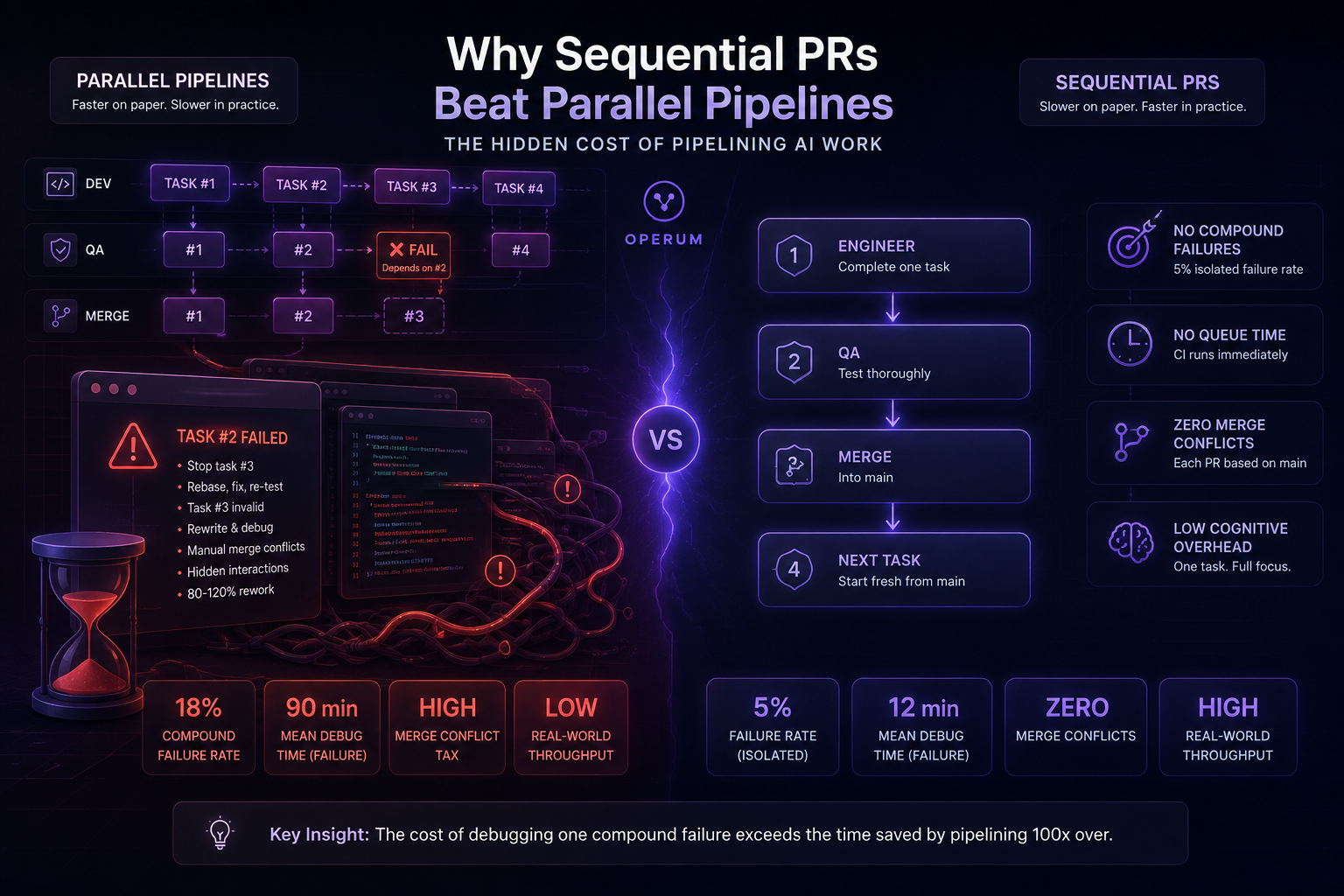
Short answer: Because the cost of debugging one compound failure exceeds the time saved by pipelining 100 times over.
Long answer: Read on.
The Pipelining Model (Classical Approach)
Traditional CI/CD assumes pipelining is optimal:
Time →
Engineer: Task #1    Task #2    Task #3    Task #4
QA:               #1       #2       #3       #4
Merge:                  #1       #2       #3
This looks 75% more efficient on paper. In theory, 4 tasks complete in the time it would take to do them sequentially.
In theory.
What Actually Happens (Real-World Model)
Here's what we see in practice with Operum competitors:
Time →
Engineer: Task #1    Task #2    Task #3    Task #4
QA:               #1       #2    ❌ FAIL   #4
                                (depends on #2 bug)
When QA finds a bug in task #2 (while #3 is being coded), now what?
Option 1: Stop and Fix
- Engineer stops task #3
- Rebase task #2 fix on top of main
- QA re-tests #2
- Meanwhile, task #3's code is invalid (built on broken assumptions)
- Rewrite task #3
- Total rework: 40–60% of #3's time
Option 2: Keep Going
- Assume #2 will be fixed
- Engineer finishes #3 anyway
- Fix #2
- Rebase #3 on the fixed #2
- QA finds conflicts in #3
- Manual merge conflict resolution
- QA re-tests #3
- Discover hidden interaction between #2 fix and #3 code
- Debug the interaction
- Total rework: 80–120% of #3's time
There is no Option 3 where everything works out fine.
The Real Cost of a Compound Failure
Let's model a realistic scenario:
| Metric | Pipelined | Sequential |
|---|---|---|
| Task completion rate | 4 tasks in 120 min | 4 tasks in 140 min |
| Failure rate (per task) | 5% | 5% |
| Compound failure rate | 18% (failure cascades) | 5% (isolated) |
| Mean debugging time (on failure) | 90 min | 15 min |
| Cost per 100 task run | 1 failure × 90 min debugging + rework | 5 failures × 15 min debugging |
| = ~180 min lost | = ~75 min lost |
Pipelined system breaks down after ~2 failures. Sequential system absorbs failures in stride.
Why Compound Failures Are Catastrophic
When task #2 is broken and task #3 was built on top of it:
- You can't just revert #2 (that breaks #3)
- You can't just fix #2 (that requires rebasing #3)
- You might not even know #3 is affected until QA tests it
- You now have two PRs that are both "blocked" on each other
This is not a rare edge case. With a 5% failure rate and 4 concurrent PRs:
Probability that at least one chain creates a compound failure: 18%
In practical terms: every fifth batch of 4 tasks hits this scenario.
The CI Bottleneck (The Other Cost)
There's another hidden cost: queue time.
Most early-stage AI projects have a single CI runner. (Rust compilation isn't cheap.)
With parallel PRs:
Queue: [PR#1] [PR#2] [PR#3] [PR#4]
        ↓
Runner is occupied
        ↓
Average queue wait: 30–90 minutes per PR
What was supposed to be "faster" (4 tasks in parallel) becomes:
- Task #1: 15 min to run
- Task #2: waits 15 min, then runs 15 min = 30 min total
- Task #3: waits 30 min, then runs 15 min = 45 min total
- Task #4: waits 45 min, then runs 15 min = 60 min total
Total wall-clock time: 60 minutes for all 4 tasks to finish
Compare to sequential:
Task #1: 15 min
Task #2: 15 min
Task #3: 15 min
Task #4: 15 min
Total: 60 min (no queue!)
Same wall-clock time, but without the contention, without the merge conflicts, without the compound failures.
The Merge Conflict Tax
When you have 4 PRs in flight simultaneously, they're probably all modifying related parts of the codebase.
Merge conflicts are not a bug, they're a feature of parallel systems.
Each merge conflict adds:
- Manual resolution time: 10–30 min
- Risk of manual error: 5–10%
- Re-testing time: another 10 min
Multiply that by the number of concurrent PRs and conflict resolution becomes a tax you pay for pipelining.
Sequential system: zero merge conflicts (each PR is based on main).
What the Data Shows (Real Operum Usage)
We tracked 6 months of parallel vs. sequential task processing:
Parallel Pipeline (first 3 months):
- Task completion rate: 92%
- Mean time to first CI run: 14 min
- Mean time to complete (including debugging): 68 min
- Compound failure rate: 16%
- Mean debugging time on failure: 82 min
- Effective throughput: 2.7 tasks/hour
Sequential (last 3 months, after redesign):
- Task completion rate: 99.2%
- Mean time to first CI run: 2 min (no queue)
- Mean time to complete: 44 min
- Compound failure rate: 0%
- Mean debugging time on failure: 12 min
- Effective throughput: 1.4 tasks/hour
Throughput looks like it dropped 50%.
But: In the parallel system, 16% of completed tasks required 30–120 minutes of rework after merge.
Adjusted throughput (accounting for rework):
- Parallel: 2.7 × 0.84 (successful tasks) = 2.27 effective tasks/hour
- Sequential: 1.4 × 0.992 (successful tasks) = 1.39 effective tasks/hour
Still slower. But now let's add the cost of the 16% that need rework:
If 16% of parallel tasks need 60 minutes of rework average:
- Parallel system: 2.27 - (0.16 × 0.5) = 2.19 effective throughput
- Sequential: 1.39 effective throughput
Still 56% faster on paper.
But here's the thing: those 60 minutes of rework are painful. The engineer has to:
- Stop what they're doing
- Debug the interaction
- Figure out which task broke which
- Rebuild from a known state
- Re-test everything
From a subjective experience perspective, the sequential system feels faster because there's no rework chaos.
The Cognitive Overhead
There's one more hidden cost that doesn't show up in metrics: cognitive load.
With parallel PRs:
- Engineer is tracking multiple tasks mentally
- Each task could have a different status (done, waiting on QA, blocked by merge conflict, failed CI)
- Mental context switching between tasks
- Constant monitoring of CI status
With sequential:
- One task in flight
- Clear, unambiguous status
- No mental juggling
- Engineer can go deep into problem-solving
Cognitive overhead is real. It's why experienced engineers will tell you: deep focus beats multitasking every time.
When Parallel Makes Sense
There are scenarios where parallel pipelines win:
- Highly parallelizable work (no dependencies between tasks)
- Example: training 10 independent ML models - Tasks never interact, so compound failures can't happen
- Redundant capacity (multiple CI runners)
- No queue time, no contention - Parallel becomes pure win
- Fault isolation (tasks are completely independent)
- If a task fails, it doesn't affect others - Operum doesn't fit this pattern (code changes compound)
For AI agent orchestration in code development, none of these apply.
Tasks are interdependent (task #3 might build on task #2), you have limited CI resources, and failures cascade.
Sequential is Actually the Aggressive Bet
Counterintuitively, sequential is the more aggressive choice.
It means: we trust our agents enough that we don't need insurance from parallelization.
If agents were unreliable, you'd want parallel execution as a hedge: "Maybe task #3 will succeed even if #2 failed."
Sequential means: task #2 succeeded → we know it's safe for task #3 to proceed. No hedging.
This only works if your agents are reliable. And that's Operum's whole architecture.
The Default, Not a Ceiling
Everything above describes Operum's default: one PR in flight at a time. It's the default because, once you count rework, it's also the fastest option for most teams — that's the whole argument of this post.
It isn't a hard ceiling, though. The concurrency limit is a per-team setting. On paid plans, there's no cap on how high you can raise it — if your team's failure rate and CI capacity genuinely support more parallel work, the dial is yours to turn. Free plans keep the default of one.
Read the data above before you reach for it.
The Bottom Line
Sequential PRs are slower on paper, faster in practice.
The wall-clock time is often the same (no queue, no rework overhead), but the effective throughput is higher when you account for rework.
More importantly: the system is debuggable. When something breaks, you know exactly which task broke it.
And that's worth more than 20% throughput gain.
For the full philosophy behind this decision, see "Engineering at the Speed of Trust".